The part no press brake can make — and why most instant quotes will sell it to you anyway
We fed a physically impossible sheet metal part to automated quoting systems. Most priced it without blinking. Here is why that happens, how our engine catches it, and what it means as AI agents start ordering parts.
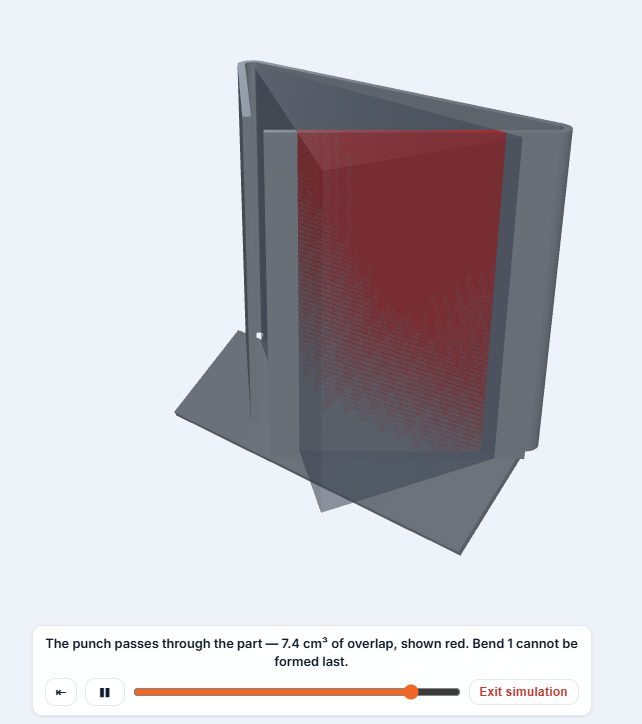
There's a sheet metal part sitting on our server that cannot be made. Not
"difficult." Not "expensive." Impossible — and it took us a while to be able
to prove why.
It looks harmless: a folded channel, three bends, clean geometry, exports
from CAD without a complaint. You can 3D print it. You could machine it from
billet. But you cannot bend it, because of a fact about press brakes that
no CAD file records: some bend has to be formed last, and at that moment
the punch is still in the machine. On this part, whichever bend you save
for last, the finished walls wrap around the space the tool needs to occupy.
Every bend order fails. The part traps the tool.
Most instant quotes will happily sell it to you
We tested this part against automated quoting flows, including one of the
new AI-agent ordering systems. Most of them priced it in seconds. Material,
bends counted, lead time promised, checkout button ready.
That's not because the people behind them are careless. It's because
detecting this failure is genuinely hard. The part unfolds to a perfectly
valid flat pattern. The bend angles are all achievable. Each bend, checked
on its own, is fine. The impossibility only appears when you ask a question
most quoting software never asks: is there a sequence of bends where the
tool can physically reach every bend line?
A quote that skips that question isn't really a quote. It's an invoice for
an argument you'll have in two weeks.
What our engine does instead
When you upload a sheet metal part to our quote page, the analysis doesn't
just count bends. It seats a conservative model of a press-brake punch on
every bend line of the finished part and measures — with actual boolean
geometry, in cubic millimetres — whether the tool and the part try to occupy
the same space. If every bend line is blocked, no bend order exists, and the
part is marked not bendable. It cannot be added to an order.
And because "trust us, it can't be made" is a frustrating sentence to
receive, the quote page shows you why: a simulation of your part folding
up bend by bend on a schematic press brake, ending with the punch seated on
the finished part and the interference painted red. On our impossible
channel, the overlap is 3.7 to 7.4 cubic centimetres of tool passing through
metal — on every one of the three bends. You can drag the timeline and watch
it happen.
Honesty about the limits: our tooling model is a straight 30° punch. A part
that only forms with specialty gooseneck tooling may get flagged for a
conversation instead of an instant price, and a manufacturing engineer still
reviews every order before production. We'd rather have that conversation
before you've paid than after we've cut material.
Why this matters more now than it did last year
There's a wave of effort to let AI assistants order custom parts directly —
open standards like the Universal Fabrication Protocol aim to let an agent
send geometry, material and quantity to a network of shops and get machine-
readable prices back. The direction makes sense; procurement really is
slower than design.
But it raises the stakes on exactly the weakness above. A human engineer
staring at a quote might pause and think "wait, how would the brake even
reach that flange?" An AI agent comparing five deterministic prices will
cheerfully buy the cheapest impossible part in the batch. Deterministic
pricing without deterministic manufacturability just automates the
purchase of scrap.
Whatever protocol wins, the shops worth connecting to will be the ones whose
"yes" means yes — where the price comes with a proof that the part can
exist. That's the part of quoting we've put our effort into, and it's why
the rejection screen on our site comes with a simulation instead of a
shrug.
Try it on your own part
Upload a STEP file on our instant quote page. If your part can be
made, you'll have an itemised price in about a minute. If it can't, you'll
see exactly why — which, we'd argue, is worth even more. Files are analysed
automatically and deleted after 48 hours; your design stays yours.
Need a part made?
Upload your file for an instant price.